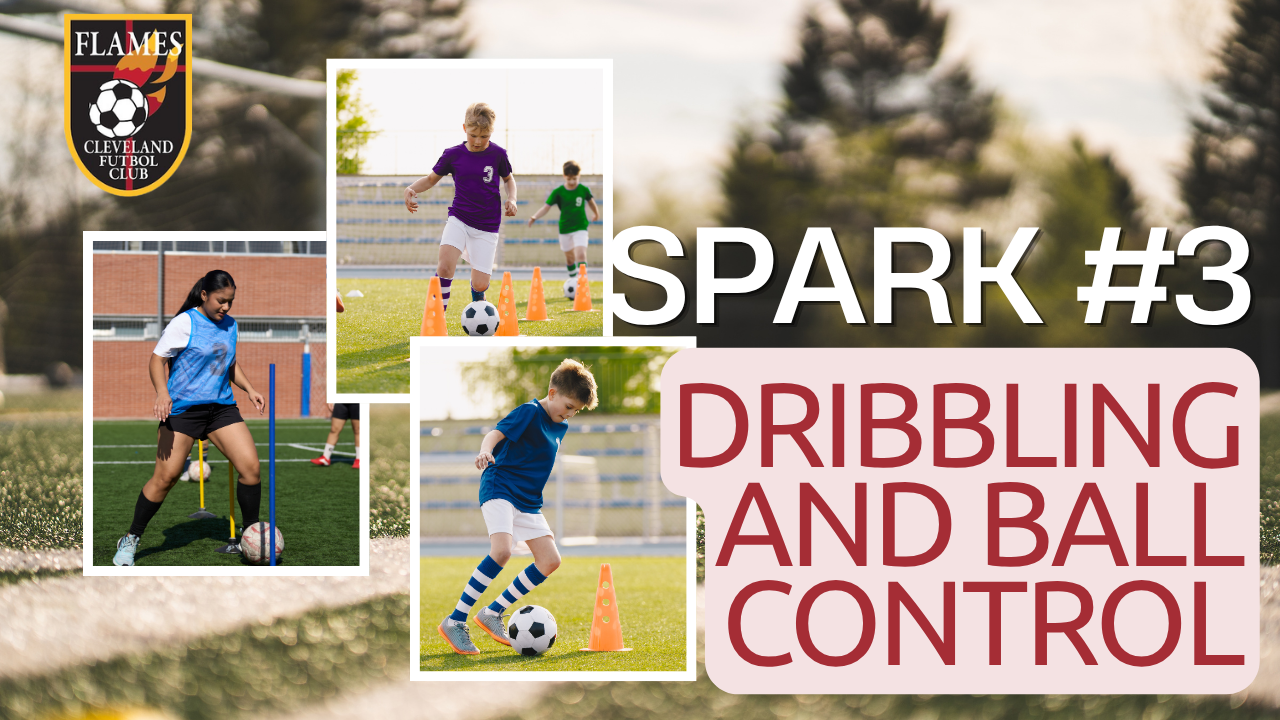
Some of the biggest improvements a young soccer player can make happen far away from a formal training session.
They happen in the driveway. In the basement. In the backyard. In a small patch of grass with a ball at their feet and a few uninterrupted minutes to experiment.
That is the heart of SPARK At-Home Training.
This week’s focus is Dribbling and Ball Control, but before getting into the daily activities, it is worth understanding why touches on the ball matter so much.
Why Touches Matter
Soccer is a game of decisions, but those decisions become much harder when a player is uncomfortable with the ball.
A player may recognize the right pass, the open space or the opportunity to turn, but if controlling the ball requires all of their attention, the game can feel very fast. Every touch becomes a small emergency.
Ball mastery helps change that.
As players accumulate quality touches, basic movements begin to feel more natural. Controlling the ball, changing direction, using the weaker foot and adjusting the ball into space require less conscious thought.
That matters because it allows players to spend more of their attention on the game around them.
Instead of thinking, “How do I control this ball?” a player can begin thinking:
Where is the defender?
Where is my teammate?
Can I turn?
Is there space to attack?
That transition is a major part of player development.
Repetition Builds Confidence
Players often think confidence comes from having a great game. In reality, confidence is usually built much earlier through preparation.
When a player has completed hundreds or thousands of touches outside of training, the ball begins to feel familiar.
They have seen it roll slightly too far away.
They have recovered from a bad touch.
They have tried the same move dozens of times.
They have used both feet.
They have figured out how much force is needed to move the ball two feet instead of ten.
Those small experiences accumulate.
There is no shortcut around repetition, but repetition does not have to be boring. A player who spends 10 focused minutes with the ball several times a week can build an enormous library of movements over the course of a season.
Ball Mastery Is About More Than Tricks
Ball mastery is sometimes confused with learning complicated moves.
Moves can be useful, but that is only one small part of the picture.
True ball mastery is about having a relationship with the ball that allows a player to manipulate it comfortably and intentionally.
Can the player:
- Keep the ball close in traffic?
- Move it with the inside and outside of either foot?
- Stop and start quickly?
- Pull it away from pressure?
- Change direction without losing balance?
- Accelerate into open space?
- Use the weaker foot when the situation demands it?
These abilities show up constantly during games.
A simple inside touch to escape pressure can be more valuable than an elaborate move. A well-controlled turn can create several yards of space. A confident touch with the weaker foot can allow a player to attack an opportunity that would otherwise disappear.
That is what we want players to begin developing through SPARK.
Why At-Home Training Is So Valuable
Team practices are essential, but training time is limited.
Coaches have to work on team concepts, small-sided games, technical activities, tactical ideas and match preparation. There simply is not enough time during organized sessions for every player to accumulate all the repetitions they need.
At-home training fills that gap.
Ten minutes does not sound like much.
But if a player completes several hundred touches during those 10 minutes and repeats that habit throughout the season, those touches begin to stack up quickly.
More importantly, players begin taking ownership of their own development.
They learn that improvement does not only happen when a coach is standing nearby.
That is a powerful habit.
This Week’s SPARK: Dribbling and Ball Control
For Week 3, players will focus on keeping the ball close, changing direction, using different surfaces of the feet and learning to control the ball at different speeds.
All players need is:
- A soccer ball
- Four to six cones or household markers
- A small, safe training space
- About 10 focused minutes each day
Shoes, water bottles or other safe objects can easily replace cones.
The emphasis throughout the week should remain the same:
Control first. Speed second.
Players should become comfortable with the movement before trying to perform it faster.
Day 1: Close Control Foundation
Begin with 100 small touches using both feet.
Players can create a small square and dribble freely inside it while trying to keep the ball within one step of their body.
Use the inside and outside of both feet and experiment with changing direction.
Players should stay light on their feet and avoid taking large touches that cause them to chase the ball.
A helpful challenge is to occasionally look up while dribbling.
Can you see something in the room or yard without losing control of the ball?
This begins connecting technical ability with the awareness players need during matches.
Day 2: Change Direction
Set up four or five cones or markers.
Dribble around them using inside and outside touches while changing direction every few steps.
Players should practice turning both left and right instead of always favoring their preferred side.
The ability to change direction quickly is critical in soccer because defenders constantly influence where attackers can move.
A player who can comfortably adjust the ball with either foot has more options.
Day 3: Sole Rolls and Pullbacks
Use the sole of the foot to roll the ball from side to side.
Once that becomes comfortable, add pullbacks by placing the foot on top of the ball and dragging it backward.
Complete three rounds of 30 seconds.
Players should focus on maintaining balance and keeping their body relaxed.
Sole rolls and pullbacks are useful because they teach players to manipulate the ball in tight spaces where there may not be room for a traditional dribble.
These movements can also become the foundation for turns, escapes and changes of direction later.
Day 4: Speed Dribble
Now we begin connecting close control with open space.
Start with the ball close to the feet. Then push the ball slightly farther forward and accelerate for approximately five yards.
Slow down, regain close control, turn and repeat.
Complete eight to ten repetitions.
Players should notice the difference between dribbling in traffic and dribbling into space.
When defenders are nearby, smaller touches usually provide more control.
When open field appears, a player can take a larger touch and accelerate.
Learning when to switch between those two styles of dribbling is an important part of becoming an effective attacker.
Weekend SPARK Challenge
Create a short cone course using whatever space is available.
Complete the course:
Three times using only the right foot.
Three times using only the left foot.
Three times using both feet.
Players should try to improve their control with each attempt.
More experienced players can add a turn or move at each cone, increase their speed or challenge themselves to keep their head up more frequently.
Younger or newer players should slow everything down and focus on clean touches, balance and using both feet.
What Parents Should Look For
Parents do not need to coach every movement.
One of the best things adults can do during SPARK training is encourage effort, creativity and consistency.
Instead of asking, “Did you do it perfectly?” try asking:
Which foot felt easier today?
What was difficult?
What movement improved after a few tries?
Can you do it a little more smoothly tomorrow?
Those questions help players think about their own development.
Mistakes are part of the process.
A player who occasionally loses the ball while experimenting is learning more than a player who never leaves their comfort zone.
Small Touches Add Up
No single 10-minute training session is going to transform a player overnight.
That is not the point.
Player development happens through accumulation.
One touch becomes ten.
Ten becomes one hundred.
One hundred becomes thousands over the course of a season.
Those touches gradually become cleaner movements, faster decisions and greater confidence.
That is why SPARK is built around small, manageable sessions players can repeat consistently.
The goal is not to turn home training into another obligation.
The goal is to encourage players to spend a little more time with the ball, experiment with their skills and discover what they can improve on their own.
Keep the ball close.
Use both feet.
Try something new.
And remember:
The goal is not perfection. The goal is progress.
Keep putting in the touches and keep your SPARK growing.